
3 Tools for Leading & Managing Change in F&B Businesses
Jul 10, 2026
We are thrilled to welcome Jennifer Burgess, owner of Plus One Hospitality, as a returning Guest Coach in The Walk-In: a 6 month group coaching program to become the leader you’ve always needed in this industry.
Jen spent over a decade working for top NYC restaurateurs Jean‑Georges Vongerichten and Danny Meyer and has held every front‑of‑house role across diverse concepts, markets and service styles. She now leads Plus One Hospitality, where she has spent 14+ years as a regional F&B trainer for Four Seasons, and consulting for private clubs and luxury hotel brands across the hospitality industry.
Members of The Walk-In benefit from coaching support from experts like Jen during the program, giving you a place to ask your burning questions about topics like, HR, management training, marketing, and team dynamics.
In this blog on practical tools for leading and managing change in F&B businesses, Jen shares practical guidance for the ever-present work of growing trust on teams and building stronger cultures while facing the constant changes that are required to exist and evolve in this industry.
We hope you learn as much from this article as we did.
Alison & Kimberly

By Jen Burgess of Plus One Hospitality
Intro
If you’ve ever led a team, chances are you’ve had this thought countless times:
“I’ve asked this employee to…
- be on time
- use a tray
- stop saying “no problem”
- check out with a manager before leaving
…dozens of times, and still nothing has changed.
I’ve tried positive reinforcement, I’ve tried posting signs, I’ve tried threatening progressive discipline, I’ve tried being the good and the bad cop, I’ve tried calling them out at pre-shift, I’ve tried letting things slide, and I’ve tried incentivizing them. Nothing works.
What’s wrong with them? What’s wrong with me?”
If you see yourself in this, keep reading.
Why Change Management Matters in F&B Businesses
The good and bad news is that there is likely nothing wrong with anyone. Changing a person, or a process, can be difficult for reasons well beyond just the normal range of resistance.
On a primitive level, change stimulates a sequence of responses in the brain and limbic system that triggers your fight-or-flight response. Then it compounds the matter by “tagging” this terrifying or stressful event with a strong emotional significance, to ensure that the next time you encounter a similar situation, you’ll recognize the danger instantly and react even faster. Said differently, we humans can be quite resistant to change.
So, you may be asking an employee to make what looks like a relatively benign change, like using new inventory software, taking a different day off, or using a new PTO form. Easy, right? Think again. That employee’s primitive brain will respond as if they were being chased by a sabretooth tiger.
Does this mean humans are incapable of change? Of course not. Our lives are constantly in flux: consciously or not, we change all the time, our hairstyle, our friends and partners, our route home from work, our jobs. Change is absolutely something we have the capacity for.
But creating real, lasting change, and pushing past the initial or ongoing resistance, takes intention. We’re just not wired to be drawn to it.
For leaders like you, whose job is to foster improvement and evolution, this means showing up with kindness and tact, the willingness to give direct and honest feedback, and the discipline to communicate consistently, so every leader is aligned, channeling behavior in the same direction, and modeling it themselves.
You already know your role demands thoughtful communication. What you might not know is exactly what that looks like in practice, especially during times of change.
In my career, I’ve found three tools that help manage change: how to keep the right people in the loop, how to approach the change itself, and how to give feedback and guardrails along the way, so everyone feels the change is happening for and with them, not to them.

Tool #1: The Lily Pad Effect
What Is The Lily Pad Effect?
A mentor of mine at Union Square Hospitality Group, Richard Coraine, shared this effective metaphor with young leaders to help them understand the impact of their decisions, and how to communicate about them.
It involves 2 components: frogs on lily pads, and rocks.
Picture yourself, and everyone on your team, as a frog sitting on their own lily pad in a shared pond. Any change, communication, or decision is a rock dropped into that water.
Based on the laws of physics, we know a few things for certain:
- Dropping a rock in the water causes a ripple effect.
- The larger the rock, the more substantial the ripple, and the further it reaches.
- The closer you are to where the rock drops, the stronger you’ll feel the ripple.
Why This Tool Works in F&B Operations
Whether you’re communicating something substantial (a boulder), like a change to your payroll system, or something minor (a pebble), like a wine by the glass that’s 86’d for the night, a different range of people will feel the ripple.
As a result, the general rule is simple: if someone’s lily pad will feel the ripple, even minimally, loop them in ahead of time. That’s the difference between something happening with or for them (they knew it was coming) and something happening to them (they felt the ripple with no warning).
On the flip side, if they won’t feel the ripple, leave them off the communication rather than copying them “just in case.” That kind of over-communicating is what creates a logjam of unread emails, and makes it harder for your team to tell what’s actually a priority.
Let’s look at a couple examples more closely.
A change to your payroll system impacts everyone, and deeply, so you’d want to:
- Be inclusive and thorough with disseminating the new information
- Deliver the message with a generous lead time
- Use different methods for different groups of employees
HR and Finance need to know first, with the most detail, followed by emails and meetings with mid-to-senior management across departments, then verbal, printed, and email notices to all employees. Plan a few follow-up meetings after the change goes live to handle ongoing questions. Third-party vendors and guests can be left off the list, since a change like this doesn’t directly affect them.
For an 86’d wine, the “need to know” list is much shorter. Tell the team working that shift, post it on the bulletin board, and add it to the pre-shift notes in case it’s still 86’d tomorrow. Let purchasing know so they can follow up with the vendor. And obviously, tell the guest, so they don’t order it! Engineering, landscaping, housekeeping, stewarding, and the kitchen team don’t need to know at all, since it has no effect on them.
This tool works well for F&B leaders because you’re constantly making in-the-moment choices about who to communicate with, and how. It’s a simple, visual way to make faster, more aligned decisions on the spot, and a framework for building a thoughtful communication strategy for bigger changes.
Tool #2: Constant Gentle Pressure
What Is Constant Gentle Pressure?
I’m fortunate to have spent my early career at Union Square Hospitality Group, learning from Danny Meyer himself, who championed the “constant, gentle pressure” approach to management. He often illustrated it with the example of “centering the saltshaker,” which works both literally and figuratively.
Let’s pretend you actually wanted to change the location of the salt and pepper shakers as part of a tabletop redesign. Instead of the center of the table, where they’ve sat for the restaurant’s entire 15-year history, they’ll now go in the left-hand corner, salt on the left, pepper on the right.
Great. Now all you have to do is tell the team what’s changing and when it starts, and from that date on, it’ll be done the new way forever. Right? Easy.
Day 1: you make your rounds and, to your surprise, everyone’s still placing the shakers in the old spot. You remind the team at pre-shift (even though you’ve been talking about this for weeks, you give them the benefit of the doubt), ask if there are any questions, and they assure you it was an oversight. They’ll get it right tomorrow.
Day 2: you spot-check the room again, and they’re still doing it the old way. You mention it more firmly at pre-shift, ask again if there are any issues, and they apologize and promise to nail it tomorrow.
Day 3: some shakers are in the old spot, some in the new spot, some halfway between. It looks like progress, at least they’re tracking in the right direction. You have a firmer conversation, call out a few people who are still getting it wrong, and ask them to get it right tomorrow. How long do you have to keep talking about this?
Day 4: you’re confident the dining room will look immaculate, but notice that while most shakers are now in the right spot, some are swapped, salt on the right, pepper on the left. Still progress, you tell yourself, while internally fuming. You’re questioning their mental capacity, and your own. What’s so confusing about this? Why can’t they make this simple change? Again: what’s wrong with them? What’s wrong with me?
Day 5: you come in already defeated, and somehow every salt and pepper shaker in the restaurant has disappeared. Who knows where they went. You lose it, throw up your hands, and give up. Put the shakers wherever you want, you tell the team. You don’t have the time or bandwidth to handhold, and you’ve got a dozen other training topics to get to.
Now, instead of improving things, you’ve created more chaos: some people doing it the new way, some the old way, and some with no idea what’s going on.
Figuratively, the saltshaker represents your standards, how you behave and what you expect of your team. It’s your job as a leader to nudge that saltshaker back into place whenever it veers off track. Whether it’s a deeper issue (grooming, attitude, punctuality) or a simple adjustment (posture, verbiage, tray usage), each piece of constant, gentle pressure plays its own role in holding people accountable to those standards.
Constant, meaning:
- Unwavering Consistency: Standards are upheld every day, not just occasionally.
- No Mixed Messages: Don’t let things slide, or let managers use different approaches and priorities, since that confuses the team about what’s truly important.
- Level Playing Field: All employees, regardless of position or tenure, are held to the same standards.
- Ongoing Dialogue: Regular, small conversations work better than infrequent, large confrontations.
Gentle, meaning:
- Radical Candor: Give feedback and make corrections with kindness, tact, and dignity (see Tool #3)
- Supportive Guidance: You’re a coach, not a judge. Focus on helping people improve, not shaming or criticizing them.
- Empathy & Understanding: Acknowledge that mistakes happen, and foster a culture where learning is encouraged.
- Preserve Dignity: Make sure maintaining standards doesn’t diminish a team member’s self-worth.
Pressure, meaning:
- High Expectations: Clearly define and uphold your standards of excellence.
- Commitment to Excellence: Your unwavering belief in the standards, and your willingness to lead by example, drives the team toward high performance.
- Blanket Accountability: Make sure team members understand their individual and collective responsibilities, and hold them accountable for meeting expectations.
- Clear Boundaries: Establish non-negotiable core values and performance benchmarks that guide every action.
Why This Tool Works for Restaurant Owners
It’s a common misconception that habits form or break in 21 days; the real range is closer to 18 to 254 days. That means you may have to remind your team where the salt and pepper shakers go, literally or metaphorically, almost every day for the better part of a year. It’s exhausting, and it’s also the most critical part of management: your ability to hold your team accountable, day after day, is where change succeeds or fails.
Constant Gentle Pressure works for restaurant owners because it reframes the problem: having to repeat yourself isn’t something to get worked up about, it’s the expectation. Your job as a leader is to stay disciplined and see the process through.
Tool #3: Radical Candor
What is Radical Candor?
Radical Candor is both a book title and a management philosophy from Kim Scott, a Silicon Valley tech executive turned leadership coach. Her premise: effective managers care personally about their teams while challenging them directly to improve.
It’s easiest to picture graphically, as two axes intersecting to create four quadrants.
The horizontal axis tracks your willingness to challenge a behavior, from clear and direct (Challenge Directly) to avoidance, where there’s no communication at all (Silence).
The vertical axis gauges how that feedback is delivered, from caring deeply about how a person receives it (Care Personally) to not taking their feelings into account at all (Not Giving a $#@!).
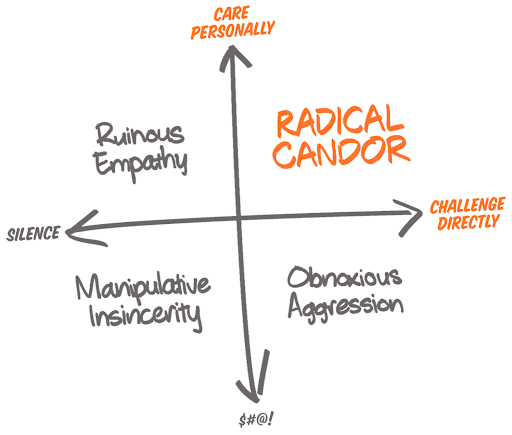
It helps to first understand what Radical Candor is not:
- It is not Obnoxious Aggression: a willingness to give feedback, but no care for how it’s delivered or received. It may be clear, but it feels harsh, dismissive, or insulting, blunt honesty without empathy.
- Result: Damages relationships, discourages dialogue, and teams perform only to avoid negative attention.
- It is also not Manipulative Insincerity: passive aggression, with neither clarity nor care in the message. Criticism repackaged with snark or sarcasm, or shared with everyone except the person it’s actually about.
- Result: Creates mistrust, promotes back-stabbing, and erodes team culture.
- And finally, it is not Ruinous Empathy: over-empathizing to the point that we don’t say anything at all. It prioritizes being nice over being honest, avoiding hard conversations to spare feelings, yours or theirs.
- Result: Causes confusion and inconsistency, impedes progress, and leaves teams without a real gauge of performance.
Radical Candor is the ideal intersection: willing to challenge a behavior, but caring about how that feedback lands. Clear, direct, and honest, but also tactful and kind.
Why This Tool Works in F&B Operations
Restaurants are fast-paced environments that are constantly changing, and this tool works because humans are wired for growth. Each of us wants to do a good job at our core, and the only way to get the satisfaction that comes from improving is through kind, direct feedback that helps us see what we can’t see ourselves.
If your team doesn’t know what they’re doing wrong, they can’t fix it. But if you’re communicating in a way they can’t hear, it won’t land either. Radical Candor helps you close the gap between current and expected performance, without eroding anyone’s dignity.
How Restaurant Owners Can Apply All 3 Tools Together

These three tools can work separately or in tandem. They’re related, but not dependent on each other. Since they speak to an organization’s culture, they’re most effective when the whole team is using them consistently.
To accomplish this, start with a simple checklist:
- Step 1: Lily Pad Effect:
- What changes or decisions do I need to communicate, to whom, and how?
- Step 2: Constant, Gentle Pressure:
- Is my team aligned? Are we holding everyone, including ourselves, accountable to the same standards, every day?
- Step 3: Radical Candor:
- When someone’s behavior needs correcting, how do I tell them directly and honestly, but also kindly, and help them course-correct?
Rinse
Repeat (for the rest of your career!)
FAQ’s
How can these 3 tools improve F&B management?
Together, these three tools give you a complete system for change: the Lily Pad Effect helps you decide who needs to know what and when, Constant Gentle Pressure keeps your team accountable to your standards every single day, and Radical Candor gives you the language to deliver feedback honestly without damaging trust. Used together, change stops feeling like something that happens to your team, and starts feeling like something that happens with them.
Do I need to use all three tools at once, or can I start with just one?
Start with whichever one solves your most pressing problem. If communication feels chaotic, start with the Lily Pad Effect. If your standards keep slipping, start with Constant Gentle Pressure. If tough conversations keep getting avoided, start with Radical Candor. They reinforce each other, but you don’t need all three running on day one to see results.
How long does it realistically take to see results in an F&B environment?
Longer than you’d like, honestly. Habits typically take anywhere from 18 to 254 days to form or break, not the 21 days most people assume. Expect to reinforce a change daily, sometimes for the better part of a year, before it truly sticks.
How can Radical Candor help restaurant leaders?
It gives you a way to be honest without being harsh, and kind without sliding into silence. Instead of avoiding the conversation (Ruinous Empathy) or delivering feedback without care (Obnoxious Aggression), Radical Candor lets you challenge a behavior directly while still caring about the person on the receiving end. That’s the difference between a conversation that erodes trust and one that builds it.
Can the Lily Pad Effect be used for urgent changes?
Yes. Urgency just changes how fast you move through the same logic: who’s closest to the rock, and how big is it? For something big and urgent, like a same-day menu change, you’d still notify the most affected people first, like the team working that shift, with direct, fast communication, then loop in everyone else who needs to know. The principle stays the same: if someone’s going to feel the ripple, they should hear it from you before they feel it.
Conclusion: Consistency Over Intensity
Remind yourself, as often as needed, that change takes time. It involves struggle, failure, and resistance, so give yourself and your team some grace when they don’t get it right the 1st, the 20th, or the 233rd time :) But remember: the short-term pain is worth the long-term gain of a fully informed, competent, capable team, and a workplace culture that actually thrives. If you prioritize consistent communication over short, intense bursts of it, anything is possible.


